Tankless Water Heater Repair · McKinney, TX
Tankless Water Heater Repair in McKinney, TX
Tankless units break differently than tank units. Error codes. Ignition failures. Flow problems. Scale buildup. We know the difference. Call 24/7 or live chat now.
Common Tankless Water Heater Problems
Tankless units don't break the same way tank units do. Here are the most common problems we see in McKinney homes.
Error Codes
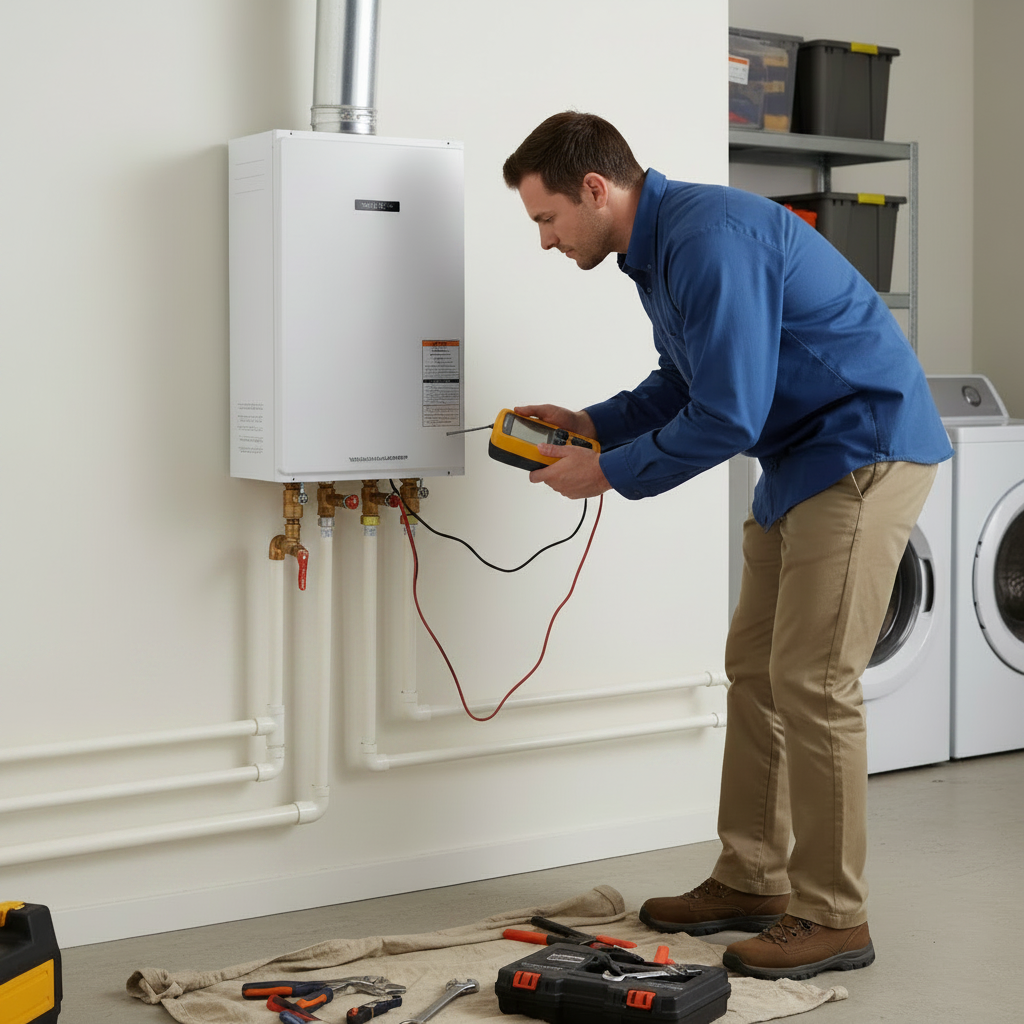
Most tankless units display a code when something fails. These codes point to ignition, flow, heat exchanger, or sensor problems.
Ignition Failure
The unit tries to fire but fails — no heat output, often with an ignition-related error code. Gas pressure, venting, and igniter condition all play a role.
Inconsistent Output Temperature
Hot water that fluctuates wildly is often a flow sensor, thermistor, or scale issue limiting the unit's ability to regulate output.
Low-Flow Activation Problems
Tankless units require a minimum flow rate to activate. If the unit won't fire at low flow, the flow sensor or the activation threshold may need adjustment.
Scale and Mineral Buildup
North Texas water is hard. Minerals build up inside the unit over time — reducing output and eventually causing damage.
Venting Issues
Improper or blocked venting can prevent the unit from firing safely. This is a safety concern and should be diagnosed by a technician.

Error Codes & Ignition
Diagnosing Error Codes and Ignition Failures
When a tankless unit stops, it usually shows you an error code. That code tells us where to look — ignition, venting, flow, or temperature.
Ignition failures are the most common. The unit tries to fire, can't confirm it's lit, and shuts down. Causes include low gas pressure, a weak igniter, a dirty burner, or a blocked vent.
- Error code diagnosis matched to specific system failures
- Gas pressure and supply line evaluation
- Igniter and flame sensor testing
- Exhaust and combustion air venting check
- Control board and wiring inspection
Maintenance
Descaling and Annual Maintenance — Why It Matters in North Texas
McKinney water is hard. Minerals build up inside the unit over time — reducing output, cutting how well it works, and eventually causing damage.
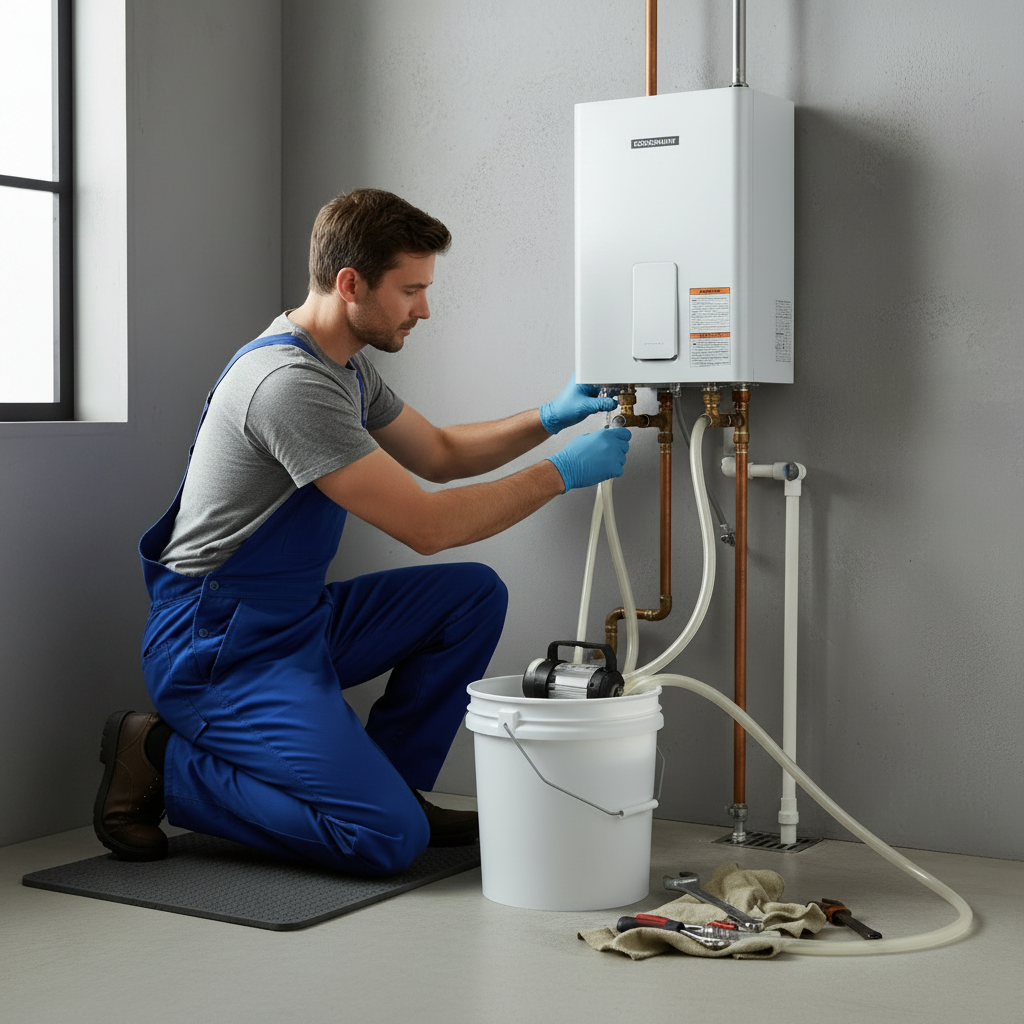
Descaling flushes those minerals out. Most manufacturers recommend it every one to two years. Skip it and the unit wears out faster. In North Texas, it's regular maintenance — not optional.
- Annual descaling recommended for most North Texas homes
- Citric acid flush removes built-up scale
- Restores output and keeps temperature consistent
- Prevents long-term internal damage
- Helps keep the manufacturer warranty valid
Repairing vs. Replacing a Tankless Unit
Most decisions come down to age, repair cost, and how the unit is performing. Here's the breakdown.
Repair Makes Sense When…
- The unit is under 8–10 years old
- The failure is an isolated component
- The heat exchanger is in good condition
- No significant scale damage has occurred
- Repair cost is reasonable vs. unit value
Replacement Is Worth Considering When…
- Unit is 10+ years old with ongoing issues
- Heat exchanger has failed or is severely scaled
- Control board has failed on an older unit
- Repair cost approaches unit replacement value
- Household hot water demand has grown beyond unit capacity
Tankless Benefits
Why McKinney Homeowners Choose Tankless
Tankless units heat water on demand. No tank to run out of. For households that use a lot of hot water at once, that's a real improvement.
They also use less energy — they only run when you need hot water, not all day maintaining a tank.
If your current tank unit is nearing the end of its life, tankless water heater installation is worth considering as a long-term upgrade — and we can help you weigh whether it makes sense for your home's usage.
- Continuous hot water supply — no running out
- More energy efficient in moderate-to-high usage homes
- Compact footprint — frees up utility room space
- Typically 20+ year lifespan with proper maintenance
- Many models can be installed outdoors for specific home layouts
Tankless Water Heater Repair in McKinney, TX — Complete Guide
How Tankless Water Heaters Work — and Why They Fail Differently
Tankless water heaters — also called on-demand or instantaneous water heaters — heat water directly as it flows through the unit rather than storing a hot volume in a tank. When you open a hot water tap, cold water enters the unit, a flow sensor detects the movement, and a gas burner or electric element fires to heat it to the set temperature before it exits.
This is fundamentally different from how a tank unit works, and those differences mean failures show up in different ways and need different diagnostic approaches. A technician who primarily works on tank units will have a harder time with a tankless error code than one who understands how flow-based heating systems work.
Common Tankless Water Heater Problems in McKinney Homes
The most common problems we see in McKinney's tankless systems fall into a few clear categories: ignition failures, flow-related activation issues, heat exchanger scale buildup, and sensor or control board failures. Understanding which category the problem falls into is the first step toward resolving it quickly.
- Ignition failure: the unit fires but can't confirm flame — error codes typically EC or F2 on most brands
- Flow activation issues: unit won't fire at low flow rates — often a flow sensor or minimum activation threshold issue
- Temperature inconsistency: hot water fluctuates — scale buildup or a faulty thermistor
- Heat exchanger scaling: reduced output over time as mineral deposits restrict water flow inside the unit
- Venting problems: blocked or improperly installed exhaust prevents combustion — a safety concern
- Control board failure: usually evident on older units with multiple error codes and inconsistent behavior
Hard Water and Tankless Systems in Collin County
North Texas water hardness is a real issue for tankless systems. The water in McKinney and surrounding Collin County cities contains dissolved calcium and magnesium minerals that precipitate out of solution when heated. Inside a tankless heat exchanger — where water is rapidly heated to high temperatures — scale forms quickly.
Manufacturers typically recommend annual descaling for homes with hard water. In McKinney, that's not a recommendation to ignore. A heat exchanger with significant scale buildup reduces the unit's efficiency, creates hot spots that shorten the exchanger's life, and can eventually cause the unit to shut down on overtemp protection.
Descaling is a maintenance service, not a repair — it's done before the unit fails, not after. A citric acid flush circulated through the heat exchanger dissolves mineral deposits and restores flow. It takes about an hour and significantly extends the remaining service life of the unit.
Reading Tankless Error Codes
One of the most useful features of modern tankless water heaters is the error code display. When the unit shuts down, it usually tells you why — in code. The specific codes vary by brand (Rinnai, Rheem, Navien, Noritz, and others all use different systems), but the categories are consistent: ignition, flow, exhaust, overheating, and sensor.
An error code is a starting point, not a final diagnosis. It tells us which system to look at — it doesn't always tell us exactly which component failed. But it narrows the field significantly and usually allows for a faster, more accurate diagnosis than a unit with no feedback at all.
Tankless Water Heater Installation vs. Repair in McKinney Homes
Tankless units are significantly more expensive than tank units — typically $800–$2,000 for the unit alone, plus installation. This changes the repair math. A $300 repair on a tankless unit that cost $1,500 three years ago is almost always worth doing. The same repair on a 14-year-old unit with a failing heat exchanger and a history of problems requires a more careful assessment.
Tankless heat exchangers are the most expensive component to replace. If the exchanger has failed, the repair cost approaches or exceeds unit replacement cost on older units. On newer units under warranty, it may be covered. We check warranty status before assuming a heat exchanger failure means automatic replacement.
McKinney Hard Water & How Response Works
How McKinney's Water Affects Tankless Units — and How to Get Help Fast
McKinney's hard water (120–180 ppm dissolved minerals) is the single biggest factor in tankless water heater problems in this market. Scale builds up inside the heat exchanger — the component where water is rapidly heated — restricting flow, reducing output, and eventually causing overheating shutdowns. In homes across Craig Ranch and Stonebridge Ranch, where tankless units were installed during construction, many are now 8–10 years old and have never been descaled.
When you call about a tankless issue, our AI assistant answers in seconds — 24/7. It captures the error code if you have one, the unit brand, and the symptoms. A $47 call-out fee secures your guaranteed response, and a local licensed plumber diagnoses the specific failure — sensor, igniter, flow valve, or scale — and recommends the right fix.
Tankless Patterns in McKinney Neighborhoods
In Trinity Falls and other newer McKinney communities, tankless units are often still under warranty, which changes the repair math. In older neighborhoods where tankless was added as an upgrade, the units may be past warranty and approaching the point where heat exchanger scaling makes repair less cost-effective. We check warranty status before recommending any major component replacement.
Tankless Water Heater Questions
Tankless Unit Not Performing?
Call 24/7 now or live chat. Same-day tankless diagnosis in McKinney.
Request Tankless Repair Service
Describe the problem — including any error codes you see. We'll respond quickly.