Still no hot water after checking the basics? Call 24/7 or live chat now — this needs a technician.
Call Now — +1 469 824 3854No Hot Water · McKinney, TX
No Hot Water in McKinney, TX
Run through the safe checks below first — most take under five minutes. If nothing changes, call 24/7 or live chat now. This is a same-day problem and we can usually get there today.
Safe Checks to Run Before Calling
These cover the most common causes that resolve without a service call. None require tools or opening the unit.
- 1
Check whether other appliances have power
A broader outage would affect other things too. If the rest of your home is working normally, the issue is isolated to the water heater or its circuit.
- 2
Find your electrical panel and look for a tripped breaker
A tripped breaker sits between ON and OFF — not fully in either position. Flip it fully OFF first, then back ON. This resets the circuit. For electric water heaters, the breaker is usually a 240V double-pole breaker.
- 3
Wait 45–60 minutes after resetting the breaker
An electric water heater needs time to bring a full tank up to temperature. If the breaker reset worked, you won't know for close to an hour. Give it time before concluding it didn't help.
- 4
On a gas unit: look for a pilot light through the sight window
Many gas water heaters have a small glass window near the bottom. If the pilot is out, it won't be visible. Check the label on the unit for relight instructions — most have them printed there.
- 5
Check the thermostat setting
On gas units, there's usually an external temperature dial. On electric units, the thermostats are behind access panels and shouldn't be opened. Just confirm the external dial (if there is one) hasn't been turned down inadvertently.
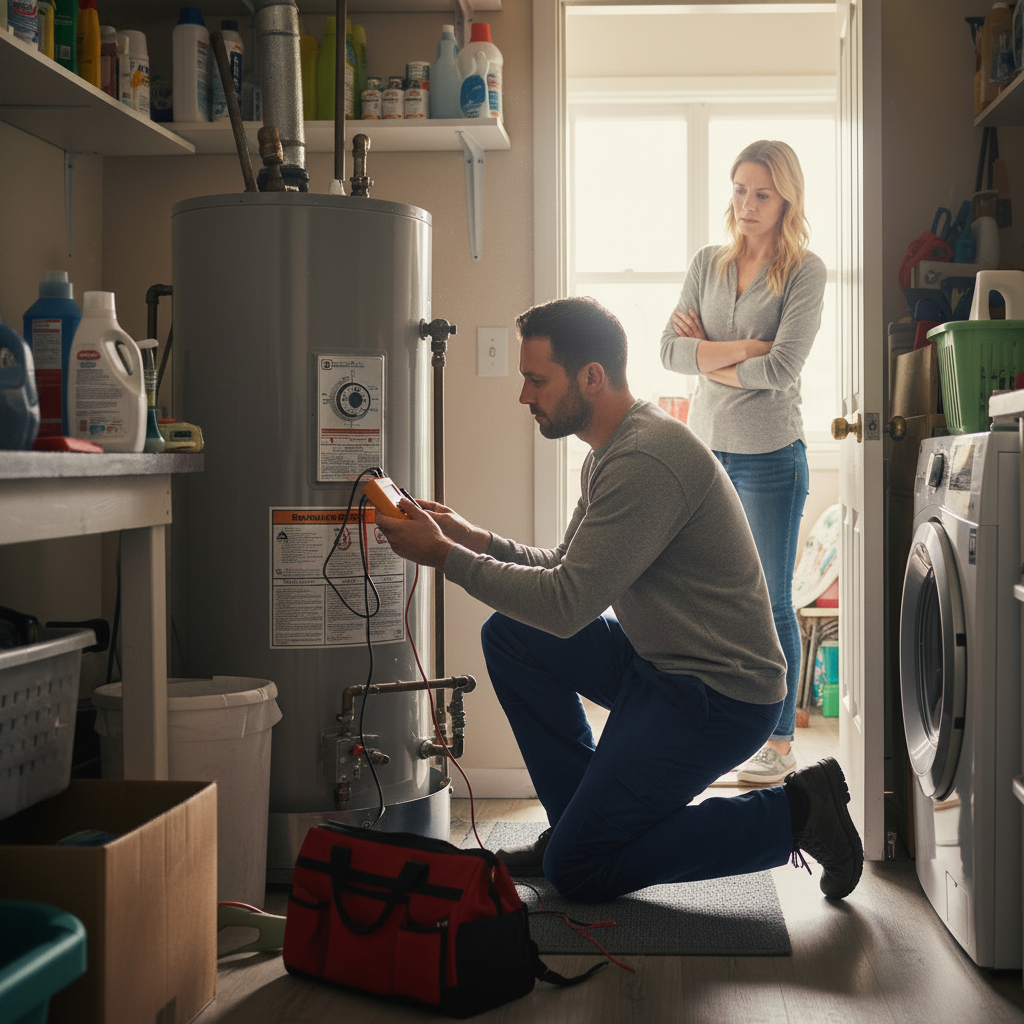
Gas Water Heaters
What Stops a Gas Unit and What Each Cause Means
Gas units fail in a predictable pattern — most problems are in the ignition and gas control system. A pilot that won't stay lit, an igniter that fires but doesn't hold, a burner that won't light — these all have different causes.
The thermocouple is the most common failure. It's the sensor that tells the gas valve the pilot is on. When it fails, the valve shuts off — no flame, no heat. Thermocouple replacement is a straightforward repair.
- Pilot went out — can sometimes be relit, but will reoccur if the thermocouple is failing
- Thermocouple failure — most common cause of a pilot that won't stay lit
- Gas valve failure — can fail in a closed or erratic position, stops all gas flow
- Burner assembly — may not ignite correctly even when the pilot is lit
- Sediment buildup — reduces heating efficiency without causing complete failure

Electric Water Heaters
Two Elements, Two Failure Patterns — They're Not the Same
Electric units have two heating elements — upper and lower — each with its own thermostat. Which one fails determines what you experience.
Upper element or tripped breaker: no hot water at all. Lower element: you get some hot water, but it runs out fast and doesn't recover. Knowing the difference tells us what to check before we arrive.
- No hot water at all → start with the breaker, then suspect the upper element
- Some hot water but runs out fast → lower element or lower thermostat
- Breaker trips again immediately after reset → shorted element, stop resetting and call
- High-temperature cutoff tripped → safety device activated, requires manual tech reset
- Elements weaken over years before failing completely — so performance decline is an early signal
When to Stop Checking and Call
If you've run through the basics and nothing changed, stop. Going further inside the unit without training isn't safe and won't help. Most components need testing equipment to diagnose correctly.
- Breaker has tripped more than once after resetting
- You'd need to remove access panels to go further
- There's any smell of gas at or near the unit
- You see any sign of burning, scorching, or discoloration
- The pilot relights but goes out again within minutes
No Hot Water in McKinney, TX — Complete Diagnostic Guide
Why You Have No Hot Water — and What To Do About It
No hot water is one of the most disruptive things that can happen in a home. It affects every member of the household immediately — showers, dishes, laundry. In McKinney, most no-hot-water calls can be resolved the same day when a technician can get there promptly.
The first step is understanding why the hot water stopped. Gas and electric units fail in different ways, and the symptoms — complete loss vs. partial loss — point to different components. Getting that right before a technician arrives means a faster diagnosis and a faster fix.
Complete Loss of Hot Water vs. Partial Loss — What the Difference Tells You
The distinction between complete and partial hot water loss is diagnostically significant. Complete loss — no hot water at all from any tap — points to different components than partial loss, where you get some hot water but it runs out faster than normal or doesn't get as hot as it should.
On electric units: complete loss usually points to the upper heating element or a tripped circuit breaker. The upper element heats the top of the tank first — if it fails, the lower element alone can't maintain temperature across the full tank volume. Partial loss — water that's warm but runs out quickly — usually points to the lower element.
On gas units: complete loss usually points to an ignition problem — the pilot is out, the thermocouple has failed, or the gas valve is closed or malfunctioning. The unit isn't heating at all. Partial loss in a gas unit often indicates a partially failed burner or a thermostat issue that limits the temperature setpoint.
Gas Water Heater: No Hot Water Causes and Diagnosis
Gas water heaters heat water through combustion — a gas burner fires beneath or within the tank, heating the water from below. The ignition and gas control system is where most failures occur. Here's how the common causes break down:
Pilot failure is the most visible problem. Many gas units have a pilot light that stays lit continuously to ignite the main burner when heat is needed. If the pilot is out, the main burner can't fire, and the tank goes cold. Some homeowners can relight the pilot themselves using the instructions printed on the unit. If the pilot won't stay lit after relighting, the thermocouple is almost certainly failing.
The thermocouple is a safety sensor that tells the gas valve the pilot is on. When the thermocouple fails, the gas valve defaults to closed — no gas, no heat. Thermocouple replacement is one of the most common and straightforward repairs on gas water heaters. It's inexpensive and highly effective when that's the actual cause.
- Pilot out — check for simple relight; if it won't stay lit, thermocouple is suspect
- Thermocouple failure — most common cause of pilot that goes out repeatedly
- Gas valve failure — can fail closed or produce erratic behavior; requires replacement
- Burner assembly — may fail to ignite properly even with functional pilot and valve
- Electronic ignition (newer units) — igniter or flame sensor failure produces error codes
- Sediment buildup — reduces heating efficiency, produces rumbling sounds, doesn't cause complete failure alone
Electric Water Heater: No Hot Water Causes and Diagnosis
Electric water heaters use two resistive heating elements — one in the upper portion of the tank and one in the lower. Each element has its own thermostat, and they operate in sequence. The upper element heats first; once the upper portion reaches temperature, the lower element takes over to heat the rest of the tank.
This sequential operation is why upper and lower element failures produce different symptoms. Upper element or breaker failure: no hot water at all. Lower element failure: you get hot water initially, but it runs out quickly and the tank recovers slowly.
The circuit breaker for an electric water heater is a 240V double-pole breaker — it looks like two breakers joined together. A tripped breaker will be in the middle position between ON and OFF. Resetting it (flip fully OFF, then back ON) is the first step when an electric unit produces no hot water. If the breaker trips again immediately, there's a fault in the circuit — stop resetting and call a technician.
When to Call vs. When to Wait
If you've run through the safe checks — reset the breaker, attempted a pilot relight, checked the thermostat — and the problem persists, that's the call point. Most components that cause complete hot water loss require testing equipment and component-level diagnosis to identify correctly.
A no-hot-water situation in McKinney is a same-day call. We can usually get there the same day for urgent situations, and a straightforward element or thermocouple replacement is a same-day fix. Don't wait on this — the problem won't resolve on its own.
McKinney Hard Water & How Response Works
How McKinney's Water Leads to No Hot Water — and How to Get Help Fast
McKinney's hard water (120–180 ppm dissolved minerals) plays a direct role in no-hot-water calls. Sediment accumulation at the bottom of the tank insulates the heating element or burner from the water, reducing output until the unit can't keep up. In homes across Stonebridge Ranch and Craig Ranch, where many units are 8–12 years old, this is the most common path from 'slow recovery' to 'no hot water at all.'
When you call with no hot water, our AI assistant answers in seconds — 24/7. It captures the details: unit type, whether you've checked the breaker or pilot, and how long it's been happening. A $47 call-out fee secures your guaranteed response, and a local licensed plumber tests the specific component — element, thermocouple, gas valve — before recommending a fix.
No-Hot-Water Patterns in McKinney Neighborhoods
In Eldorado and Tucker Hill, where homes were built in the 2000s, electric element failures are the most common cause of complete hot water loss. In Historic Downtown McKinney, gas valve and thermocouple failures show up more frequently on older gas units. The neighborhood and unit age tell us what to bring and where to start testing.
No Hot Water — Common Questions
After You Reach Out
What Happens When You Call
- 1
Run through the safe checks above first
Breaker, pilot, thermostat. If any of those resolve it, you may not need a service call at all.
- 2
If they don't fix it — call
No hot water after the basic checks is a technician problem. Don't keep resetting or experimenting — it's time to call.
- 3
We diagnose the specific component that failed
We test elements, thermostats, or gas components depending on your unit. We identify what failed — not just 'the water heater isn't working.'
- 4
We tell you whether repair or replacement makes sense for this unit
A failed heating element on a 5-year-old unit is a clear repair. The same failure on a 13-year-old unit with visible corrosion changes the math.
- 5
You decide — we do the work
Once you understand the issue and the options, the decision is yours.
Ready to get help?
Call for the fastest response — we're available 24/7. Send a message if it's not urgent — we'll follow up promptly.
Call 24/7 Now — +1 469 824 3854Mon–Fri: 7:00 AM – 7:00 PM · Sat: 8:00 AM – 5:00 PM
Request No Hot Water Service
Describe your situation and we'll follow up promptly during business hours. For urgent issues, call +1 469 824 3854 — it's faster.