Still no hot water after running the basics? Call 24/7 or live chat now — this needs a technician.
Call Now — +1 469 824 3854No Hot Water · Prosper, TX
No Hot Water in Prosper, TX
No hot water in Prosper, TX is a diagnostic problem first — not a replacement decision. Whether your home runs on a gas tank unit, an electric tank, or a tankless system, the cause of a sudden total loss of hot water comes down to a specific component: a heating element, a thermocouple, a gas valve, a flow sensor, or an ignition fault. Start with the safe checks below — most take under five minutes and cover both gas and electric units. Prosper has a population of approximately 49,400, a median household income around $195,000 — the highest of the five nearby cities — and is growing at roughly 7.5% annually with a high volume of active new construction. That new-build share means a sudden total loss of hot water in a newer home is more likely a component or installation issue than age-related wear — but this is a diagnostic page first, not a framing exercise. We identify what actually failed before recommending anything. Call 24/7 or live chat now.
Safe Checks to Run Before Calling
These address the most common causes that resolve without a service visit. None of them require tools or opening the unit.
- 1
Verify whether other appliances still have power
A wider electrical outage would knock out other devices too. If the rest of your home is working normally, the fault is limited to the water heater or its dedicated circuit.
- 2
Locate your electrical panel and check for a tripped breaker
A tripped breaker rests between ON and OFF — not firmly in either position. Push it completely OFF first, then back to ON to reset the circuit. Electric water heaters typically run on a 240V double-pole breaker.
- 3
Give it 45–60 minutes after resetting the breaker
An electric tank needs time to bring a full volume of water back up to temperature. If the reset worked, you won't know for the better part of an hour. Be patient before deciding it didn't help.
- 4
On a gas unit: inspect the pilot through the sight window
Many gas water heaters have a small viewing port near the base. If the pilot flame is out, you won't see it glowing. The relight procedure is usually printed on a label attached to the unit — follow those instructions.
- 5
Confirm the thermostat hasn't been turned down
Gas units generally have an external temperature dial. Electric units house their thermostats behind access panels that shouldn't be opened. Just verify the external dial (if present) is set where you expect it.
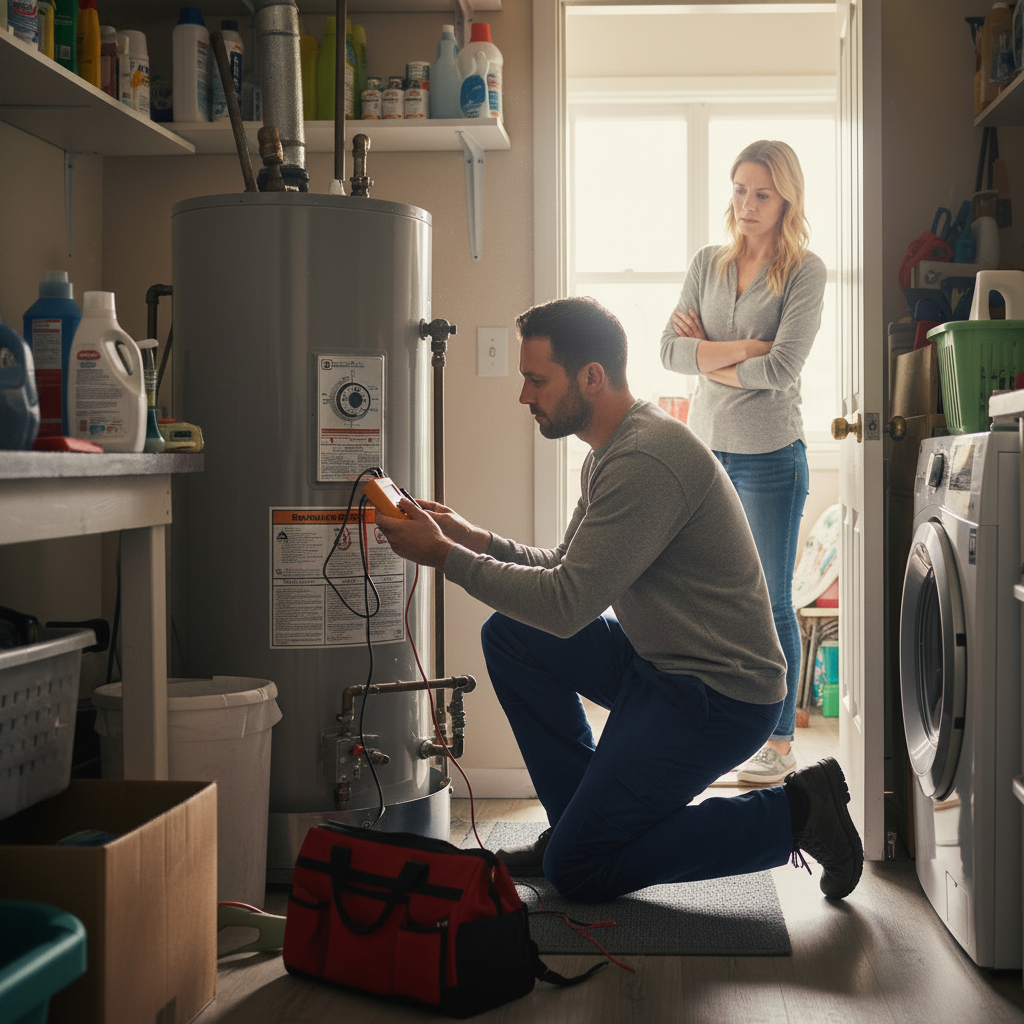
Gas Water Heaters
What Causes a Gas Unit to Stop — and What Each Failure Means
Gas water heaters tend to fail in recognizable patterns — most problems live in the ignition and gas control assembly. A pilot that won't stay lit, an igniter that sparks but can't hold the flame, or a burner that refuses to fire — each points to a different underlying cause with different repair implications.
The thermocouple is the single most common failure point. It's the small sensor that signals the gas valve that the pilot is burning. When it quits, the valve closes as a safety measure — no flame, no heat. Replacing a thermocouple is a routine, inexpensive repair on a unit that's otherwise sound, which is exactly why we diagnose before suggesting anything more involved.
- Pilot went out — sometimes relitable, but will recur if the thermocouple is on its way out
- Thermocouple failure — the leading cause of a pilot that won't stay lit
- Gas valve failure — can stick closed or behave erratically, cutting all gas flow
- Burner assembly — may not ignite properly even with a working pilot and valve
- Sediment accumulation — reduces heating efficiency without causing a total failure on its own

Electric Water Heaters
Two Elements, Two Failure Patterns — Knowing the Difference Matters
Electric tanks use two heating elements — one upper, one lower — each governed by its own thermostat. Which one fails determines what you notice at the tap, and whether a targeted repair makes sense depends on the unit's age and overall condition.
Upper element or tripped breaker: no hot water whatsoever. Lower element: you get some hot water, but it depletes quickly and the tank recovers slowly. Recognizing the difference tells us where to start testing before we arrive — and whether a focused repair is the right recommendation.
- No hot water at all → begin with the breaker, then suspect the upper element
- Some hot water but it runs out fast → lower element or lower thermostat
- Breaker trips again right after reset → shorted element, stop resetting and call
- High-temperature cutoff tripped → safety device activated, needs a manual technician reset
- Elements degrade over years before failing outright — so declining performance is an early warning sign
When to Stop Checking and Call
If you've worked through the basics and nothing improved, stop. Going deeper into the unit without training isn't safe and won't produce results. Most failed components require testing equipment to diagnose accurately.
- Breaker has tripped more than once after being reset
- You'd need to remove access panels to investigate further
- There's any gas odor at or near the unit
- You notice any burning, scorching, or discoloration
- The pilot relights but extinguishes again within minutes
Prosper, TX — Local Context
No Hot Water in Prosper, TX — Complete Diagnostic Guide
Losing hot water is one of the most immediately disruptive things that can happen in a home. Showers, dishes, laundry — every household task grinds to a halt. In Prosper, TX, most no-hot-water calls can be resolved the same day when a technician arrives promptly, and whether repair or replacement is the right path depends on which component actually failed and how much service life the unit has left.
Prosper is one of the fastest-growing communities in the region — population approximately 49,400, growing at roughly 7.5% annually, with a high volume of active new construction and a median household income around $195,000, the highest of the five nearby cities. That new-build share means a sudden total loss of hot water in a newer home is more likely a component or installation issue than age-related wear — but this is a diagnostic page first, not a framing exercise. The first step is always identifying the specific component that failed before recommending repair or replacement.
Complete Loss vs. Partial Loss — What the Distinction Tells You
The difference between complete and partial hot water loss carries real diagnostic weight. Complete loss — no hot water from any tap in the house — points to different components than partial loss, where some warm water comes through but it depletes faster than normal or never reaches full temperature.
On electric units: a complete loss typically traces to the upper heating element or a tripped circuit breaker. The upper element heats the top portion of the tank first — if it fails, the lower element alone can't sustain temperature across the full tank volume. Partial loss — lukewarm water that runs out quickly — usually points to the lower element.
On gas units: a complete loss generally points to an ignition fault — the pilot is out, the thermocouple has failed, or the gas valve is closed or malfunctioning. The unit isn't heating at all. Partial loss on a gas unit often signals a partially failed burner or a thermostat issue that caps the temperature setpoint.
On tankless units: a complete loss usually triggers an error code on the display — pointing to ignition, flow, or sensor trouble. Because tankless systems heat water on demand rather than storing it, there's no 'partial' state in the same way — you either get hot water or you don't, and the code tells us which system to inspect first.
Gas Water Heater: No Hot Water Causes and Diagnosis
Gas water heaters warm water through combustion — a burner fires beneath or inside the tank, heating from below. The ignition and gas control assembly is where most failures happen, and most of those faults are repairable on units that are otherwise in reasonable condition.
Pilot failure is the most visible issue. Many gas units rely on a pilot light that burns continuously, ready to ignite the main burner whenever heat is called for. If the pilot is out, the main burner can't fire and the tank goes cold. Some homeowners can relight the pilot using the instructions printed on the unit. If the pilot won't stay lit after relighting, the thermocouple is the likely culprit.
The thermocouple is a safety sensor that confirms to the gas valve that the pilot is burning. When it fails, the gas valve defaults to closed — no gas, no heat. Thermocouple replacement is among the most common and straightforward repairs on a gas water heater. It's inexpensive and effective when that's genuinely the cause — which is why we test before recommending anything more significant.
- Pilot out — try a simple relight; if it won't stay lit, suspect the thermocouple
- Thermocouple failure — the leading cause of a pilot that extinguishes repeatedly
- Gas valve failure — can stick closed or behave erratically; requires replacement
- Burner assembly — may not ignite properly even with a functional pilot and valve
- Electronic ignition (newer units) — igniter or flame sensor failure triggers error codes
- Sediment accumulation — lowers heating efficiency and causes rumbling, but doesn't cause complete failure alone
Electric Water Heater: No Hot Water Causes and Diagnosis
Electric water heaters use two resistive heating elements — one in the upper section of the tank and one in the lower. Each element has its own thermostat, and they fire in sequence. The upper element heats first; once the upper portion reaches the set temperature, the lower element takes over to heat the rest of the tank.
That sequential operation is why upper and lower element failures produce different symptoms. Upper element or breaker failure: no hot water at all. Lower element failure: you get hot water initially, but it runs out quickly and the tank recovers slowly. Both are typically repairable — element replacement is a standard, cost-effective fix on units that still have reasonable service life ahead of them.
The circuit breaker for an electric water heater is a 240V double-pole breaker — it looks like two breakers joined together. A tripped breaker will sit in the middle position between ON and OFF. Resetting it (push fully OFF, then back ON) is the first step when an electric unit produces no hot water. If the breaker trips again right away, there's a fault in the circuit — stop resetting and call a technician.
Tankless Water Heater: No Hot Water Causes and Diagnosis
Tankless water heaters — increasingly common in Prosper's new-construction, higher-end homes — heat water on demand rather than storing it. When a tankless unit produces no hot water, the diagnostic path is different from a tank unit. The display typically shows an error code that points to ignition, flow, exhaust, overheating, or a sensor fault.
Ignition failure is the most frequent cause: the burner attempts to fire but can't confirm the flame, and the unit locks out. Gas pressure, a weak igniter, a dirty burner, or a blocked vent can all be responsible. Flow sensor issues can also prevent the unit from activating — if the sensor doesn't detect enough flow, the unit won't fire at all. And in Collin County's hard water, scale accumulation inside the heat exchanger can progressively restrict flow and trigger an over-temperature shutdown.
Reading the error code is the first step. The code identifies which system to inspect, which narrows the diagnosis significantly. We test the specific system the code points to rather than swapping parts on a guess — and on newer units still under warranty, a targeted component repair is almost always the right call.
Repair vs. Replacement — A Balanced Approach for Prosper Homes
Because Prosper's housing stock skews newer with a high volume of recent construction, a failed component on a relatively new unit is usually a clear repair — the part is covered or inexpensive, and the rest of the system has years of service life remaining. A single failed element, thermocouple, or flow sensor doesn't point toward replacement on a unit that's only a few years old.
That said, some homes here have older units too, and the same failure on a 12- or 14-year-old tank with sediment accumulation and a corroded anode rod shifts the math. We don't default to replacement. We identify the specific component that failed, evaluate the unit's overall condition, and give you an honest recommendation. If the unit has reached the point where repair is no longer cost-effective, we explain why and walk you through your replacement options — including guidance on checking with the Town of Prosper's building department for any applicable requirements before work begins.
Hard Water and Sediment in Collin County
Collin County water is moderately hard, which means dissolved minerals collect inside water heater tanks over time. Sediment settles at the bottom, insulating the heating element or burner from the water and reducing heating efficiency until the unit can no longer keep up with demand. This is a common path from 'slow recovery' to 'no hot water at all' across the region.
For tankless units, the same minerals settle inside the heat exchanger instead — restricting flow, cutting output, and eventually triggering shutdown codes. Regular maintenance — tank flushing for tank units, descaling for tankless — extends service life and helps prevent the efficiency decline that eventually leads to no-hot-water situations. We check for sediment or scale during diagnosis because it influences whether a repair will hold or whether the unit is nearing the end of its serviceable life.
When to Call vs. When to Wait
If you've worked through the safe checks — reset the breaker, attempted a pilot relight, verified the thermostat, and for tankless units noted any error codes on the display — and the problem persists, that's the call point. Most components that cause complete hot water loss require testing equipment and component-level diagnosis to identify correctly.
A no-hot-water situation in Prosper is a same-day call. We can typically get there the same day for urgent situations, and a straightforward element, thermocouple, or sensor replacement is a same-day fix. Don't wait on this — the problem won't resolve itself.
No Hot Water — Common Questions in Prosper, TX
After You Reach Out
What Happens When You Call
- 1
Work through the safe checks above first
Breaker, pilot, thermostat dial. If any of those resolves the issue, you may not need a service visit at all.
- 2
If none of them restores hot water — call
No hot water after the basic checks is a job for a technician. Don't keep resetting the breaker or experimenting further — it's time to call.
- 3
We identify the specific component that failed
We test heating elements, thermostats, gas components, and tankless error codes based on your unit type. We pinpoint what actually failed — not just 'the water heater isn't working.'
- 4
We advise whether repair or replacement is the right call
A failed element on a newer unit is an obvious repair. The same fault on an older tank with corrosion and sediment changes the recommendation.
- 5
You make the call — we handle the work
Once you understand the problem and your options, the decision is yours.
Ready to get help?
Call for the fastest response — we're available 24/7. Send a message if it's not urgent — we'll follow up promptly.
Call 24/7 Now — +1 469 824 3854Mon–Fri: 7:00 AM – 7:00 PM · Sat: 8:00 AM – 5:00 PM
Request No Hot Water Service in Prosper, TX
Describe your situation and we'll follow up promptly during business hours. For urgent issues, call +1 469 824 3854 — it's faster.