Leaking Water Heater · Lucas, TX
Leaking Water Heater in Lucas, TX
A leaking water heater in Lucas, TX has to be diagnosed at the source before anyone recommends a fix — and that's exactly what we do. Water can come from the drain valve, a supply connection, the T&P relief valve, or the tank body itself, and each source means something different. Lucas has a population of approximately 7,600 — the smallest of the five nearby cities — with a more rural, larger-lot character than the other nearby cities. On larger rural properties, a leak can go unnoticed longer before being spotted, since utility rooms or garages may sit further from daily living areas — a practical reason to catch it early rather than wait. We trace the water to its origin first, then tell you honestly what it means. Call 24/7 or live chat now.
Honest Diagnosis First
Finding the Leak Source Before Recommending Anything
The most important step in water heater leak repair isn't the fix itself — it's identifying where the water is actually coming from. A leak at the base of the tank can originate from four very different places, and each one points to a completely different solution. Jumping to a recommendation without tracing the source is how homeowners end up replacing units that only needed a $15 valve.
We approach every leak the same way: trace the water to its origin, confirm the source in person, then explain what it means. A drain valve drip, a loose connection, and a tank body breach look similar from the outside — pooling water under or around the unit — but the right response to each is entirely different.
Where Water Heater Leaks Actually Come From
These are the most common leak sources we encounter. Understanding which one you're dealing with determines whether it's a simple repair or a replacement situation.
Drain valve at the base of the tank
The drain valve — used for flushing and sediment removal — can develop a slow drip or fail to seal fully after use. This is among the most common and least expensive leak sources to address. A worn washer or faulty valve seat is typically the cause.
Cold water inlet or hot water outlet connection
Where the plumbing meets the top of the tank, threaded fittings can loosen over years of thermal expansion and contraction. A slow drip from above the tank is often a connection issue rather than a tank problem — and connections can be re-sealed or tightened without replacing the unit.
Temperature and pressure (T&P) relief valve
The T&P valve is a safety device designed to release water if pressure or temperature climbs too high. Occasional small discharges during heating cycles are normal. But continuous dripping can point to a failing valve or a deeper pressure issue in the system.
Leak from the tank body itself
When water emerges from the steel shell — not a valve or fitting — the tank wall has corroded through from the inside. No patch or sealant can safely restore a breached tank. This is the leak source that means replacement, not repair.
Condensation on a newer unit
Sometimes what looks like a leak is actually condensation — moisture forming on the exterior of a tank when cold water fills a unit that's heating aggressively. This is more common on newer installations and typically resolves as the tank reaches operating temperature.
Corroded fitting or supply line
The supply line connecting your home's plumbing to the water heater can corrode over time, particularly at older connection points. A corroded flex line or threaded adapter is a straightforward repair — replacing the line, not the heater.
Repair or Replace — It Depends on the Source
Most decisions come down to age, repair cost, and how the unit is performing. Here's the breakdown.
Repair Is Usually the Right Call When…
- The leak is from the drain valve
- Water is dripping from a supply connection
- The T&P relief valve is the source
- A corroded supply line is leaking
- The tank body shows no corrosion
Replacement Makes Sense When…
- Water is coming from the tank body itself
- The unit is 10–12+ years old with a tank leak
- Corrosion is visible on the steel shell
- The anode rod has been fully depleted
- Multiple components are failing together
We trace the source first — then give you a recommendation based on what we actually find.
Lucas, TX — Local Context
Leaking Water Heater in Lucas, TX — Why Source Diagnosis Matters Here
Lucas is the smallest of the five nearby cities served — population approximately 7,600 — with a more rural, larger-lot character than the other nearby cities. That rural profile is directly relevant to water heater leaks in a specific way: on larger properties, a unit located in a detached utility room, a garage set back from the main living area, or an outbuilding can leak longer before anyone notices the water. By the time pooling becomes visible, a simple valve drip may have caused more water damage than necessary — which is a practical reason to catch leaks early rather than assume a small amount of water will stay small.
Lucas doesn't have a strong age or income skew like some neighboring cities, so we approach each leak with standard, balanced repair-vs-replace framing. The source of the leak matters more than the home's age. A valve or connection leak is a simple, inexpensive repair regardless of unit age — but a leak from the tank body on an older unit usually points toward replacement. We diagnose the source first and let the recommendation follow from there.
Why a Valve Leak and a Tank Leak Are Completely Different
A leak from the drain valve, a supply connection, or the T&P relief valve is a component failure — and components can be replaced without touching the tank itself. These repairs are typically modest in cost and don't depend on the unit's age. A 3-year-old unit with a faulty drain valve gets the same repair as a 13-year-old unit with the same issue.
A leak from the tank body is fundamentally different. The steel wall has corroded through from the inside — the result of years of sediment accumulation and a depleted anode rod that stopped protecting the tank lining. No external patch, sealant, or welding can safely restore a breached tank wall. When the tank body itself is the source, replacement is the only correct path, and the unit's age helps confirm that recommendation.
How We Approach Leak Diagnosis in Lucas
When you call, we ask where the water is appearing and how fast. If the leak is growing, we guide you through shutting off the cold water supply valve above the unit to limit damage while we're on the way. On-site, we trace the water back to its origin — checking the drain valve, the supply connections at the top of the tank, the T&P valve, and the tank body itself, in that order.
Only after confirming the source do we recommend a path. If it's a valve or connection: a straightforward repair with a clear cost. If it's the tank body: replacement, and we explain why with the unit's age and condition as context. The diagnosis comes first — always.
Complete Guide
Water Heater Leak Repair in Lucas, TX — What to Know
A leaking water heater is one of the most common calls we receive — and also one of the most misdiagnosed. Water under or around a tank can come from several different sources, and the right response varies significantly depending on which one it is. This guide covers what matters: identifying the source, understanding what each source means, and knowing what to do while you wait for help.
The Four Leak Sources and What Each Means
Water heater leaks fall into four categories based on origin. The drain valve — at the base of the tank, used for flushing — can develop slow drips from a worn washer or faulty seat. This is common and inexpensive to fix. Supply connections at the top of the tank can loosen over years of thermal expansion and contraction; re-sealing or tightening resolves these without replacing the unit.
The T&P relief valve — the safety device that releases water if pressure or temperature gets too high — can drip continuously if the valve is failing or if system pressure is running high. Testing the valve and the pressure determines the right fix. And the tank body itself: when water emerges from the steel shell, internal corrosion has breached the wall. This is the source that means replacement.
Repair vs. Tank Replacement — What the Source Determines
The decision between repair and replacement for a leaking unit isn't really a decision at all — it's determined by the source. Valve, connection, and T&P valve leaks are repairable regardless of the unit's age. Tank body leaks are not repairable; replacement is the only safe option.
Where the unit's age does matter is in context. If the tank body has failed on a unit that's 12+ years old, replacement was likely coming soon anyway, and the leak simply confirms it. If the tank body has failed on a relatively young unit (which is rarer), replacement is still the correct call, but it's a more unexpected situation. We walk you through the reasoning either way.
What to Do While You Wait
If the leak is small and slow, place a shallow pan or towel beneath the source to contain the water and monitor whether it's growing. If the leak is active and increasing, locate the cold water shutoff valve on the pipe above the unit — usually a lever or wheel — and turn it to the closed position. This stops water from flowing into the tank and limits damage to the surrounding area.
If you see water near any electrical connections on an electric unit, or smell gas near a gas unit, don't wait — shut off the relevant supply and call directly. Safety situations take priority over leak diagnosis.
Condensation vs. Actual Leaks
Sometimes what looks like a leak isn't one. On newer units — especially during cold-weather months when incoming water is particularly cold — condensation can form on the exterior of the tank as the unit heats aggressively. This moisture typically disappears as the tank reaches full operating temperature. If the dripping stops after the tank has been heating for 20–30 minutes, condensation is the likely explanation, not a component failure.
We help you tell the difference. If there's any uncertainty, we trace the source in person rather than assuming — because the cost of being wrong cuts both ways. Replacing a unit that only had condensation wastes money; ignoring a real tank leak risks water damage.
Permit Considerations
If a leak leads to replacement, permit requirements may apply. Permit rules vary by municipality. We recommend contacting the City of Lucas's building department directly to confirm current requirements for your specific project before installation proceeds.
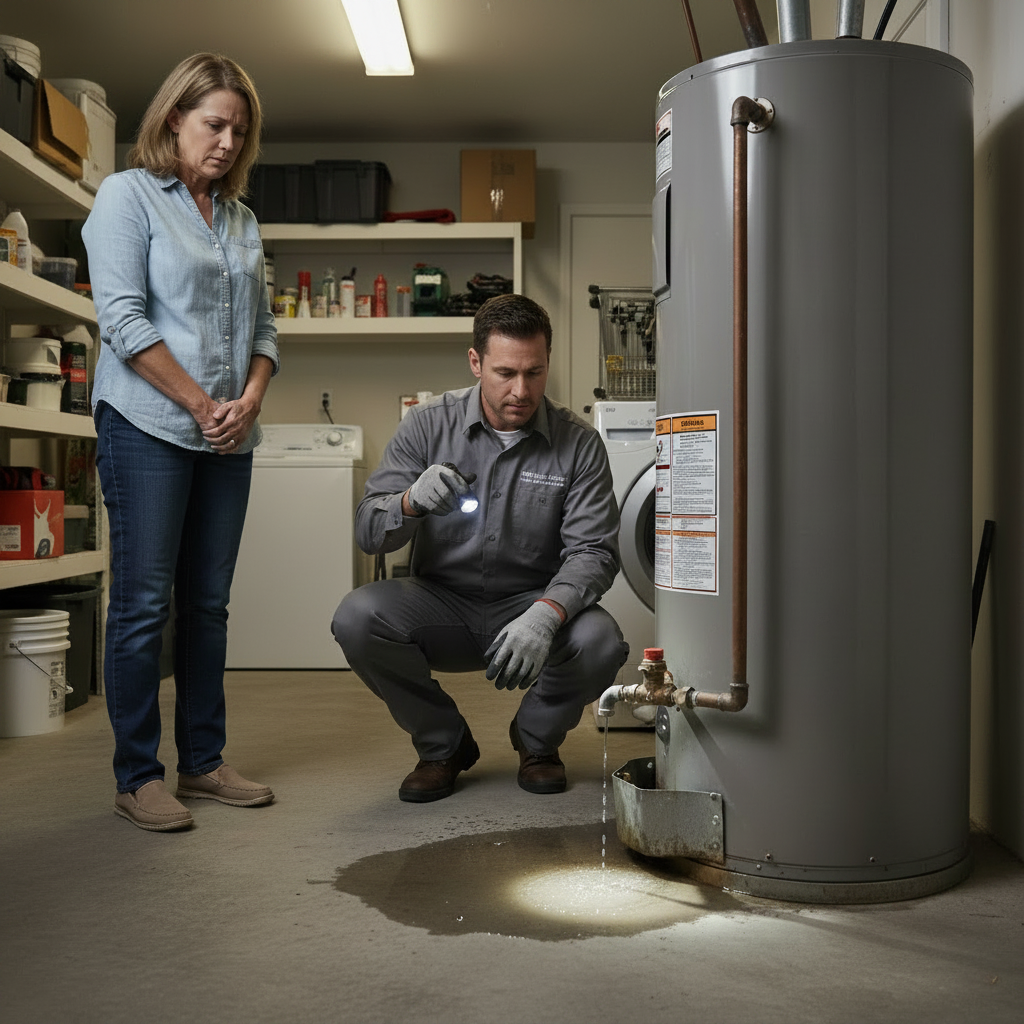
Our Diagnostic Approach
How We Trace a Water Heater Leak to Its Source
We don't guess at the source — we trace it. The diagnostic process follows a specific order because some sources are far more common than others, and ruling them out systematically is faster and more accurate than jumping to conclusions.
We start with the drain valve at the base — the most common and easiest to rule out. Then the supply connections at the top of the tank, where thermal cycling can loosen fittings over time. Next the T&P relief valve, testing both the valve itself and the system pressure. Only after those are eliminated do we assess the tank body itself for signs of wall corrosion and breach.
- Drain valve checked first — most common, simplest to rule out
- Supply connections at the top of the tank inspected for weeping
- T&P valve tested — both the valve and system pressure
- Tank body assessed last — corrosion, rust staining, and moisture pattern
- You see the source before any recommendation is made
What the Leak Diagnosis Process Looks Like
You call and describe what you see
Where the water is appearing, how fast, and whether it's coming from the tank, a valve, or a connection. Any detail helps us arrive prepared to diagnose the right source.
We isolate the actual leak source
In person, we trace the water back to its origin — drain valve, connection, T&P valve, or tank body. The source determines everything that follows. We don't assume replacement before confirming where the leak is actually coming from.
We explain what we found and what it means
If it's a valve or connection, we explain the repair clearly with the cost. If it's the tank body, we explain why replacement is the only safe option. You see the same diagnosis we see.
We give you the options with real numbers
Repair cost and replacement cost side by side, so you can decide based on the unit's age and condition. No pressure either way — the numbers make the case.
You decide — we proceed at your pace
Whether it's a valve repair or a full replacement, we move forward only after you've made the call. The information is yours.
Leaking Water Heater Questions — Lucas, TX
Water Heater Leak in Lucas, TX?
We trace the water to its actual source — valve, connection, or tank body — before recommending anything. Honest diagnosis, clear numbers, no unnecessary replacement. Call 24/7.
After You Reach Out
What Happens When You Call
- 1
You call — we answer 24/7
Describe where the water is coming from and how fast. We help you determine if there's an immediate step to take, like shutting off the cold water supply valve.
- 2
We trace the leak to its source
Drain valve, connection, T&P valve, or tank body — we identify the actual origin before recommending anything. No assumptions.
- 3
Honest repair-vs-replace guidance
If it's a valve or connection: typically a simple, inexpensive fix. If it's the tank body: replacement is the only safe call. We show you why with the numbers.
- 4
We proceed only after you decide
Repair or replacement — the decision is yours. We work at your pace with no pressure.
Ready to get help?
Call for the fastest response — we're available 24/7. Send a message if it's not urgent — we'll follow up promptly.
Call 24/7 Now — +1 469 824 3854Mon–Fri: 7:00 AM – 7:00 PM · Sat: 8:00 AM – 5:00 PM
Request Leak Diagnosis in Lucas, TX
Describe your situation and we'll follow up promptly during business hours. For urgent issues, call +1 469 824 3854 — it's faster.