Emergency Water Heater Repair · Fairview, TX
Emergency Water Heater Repair in Fairview, TX
Emergency water heater repair in Fairview, TX — available 24/7. If you're dealing with an active leak, complete loss of hot water, or a gas smell near your unit, call right now. Fairview's population of approximately 11,700 makes it the second-smallest of the five nearby cities served, with a median age of 49.1 that is notably older than the other nearby cities — meaning many homes here have aging units that are statistically more prone to sudden failures. But the first priority is always safety and stabilization: shut off the water or gas supply if you can, then call. We answer around the clock and dispatch as quickly as scheduling allows. Call 24/7 or live chat now.
Immediate Steps
What to Do Right Now Before We Arrive
The first priority in any water heater emergency is safety and damage control. The specific steps depend on what you're experiencing — an active leak, a gas smell, or a complete loss of hot water — but the principle is the same: stabilize the situation first, then get professional help on the way.
If Water Is Leaking from the Tank
Locate the cold water shutoff valve on the pipe above the unit — usually a lever or wheel. Turn it to the closed position. This stops new water from entering the leaking tank. If the leak is coming from the tank body itself (the steel shell), the unit will need replacement — no repair can safely restore a breached tank wall. If the leak is from a valve or fitting, a repair may be possible. Either way, shutting off the water supply limits damage to your home.
If You Smell Gas Near the Unit
Leave the area immediately. Do not operate light switches, appliances, phones, or anything that could create a spark. Call your gas utility's emergency line from outside the home — they handle gas safety first. Once the gas risk has been addressed by the utility, call us to inspect the water heater and determine what caused the issue.
This is not a situation to diagnose yourself. Gas-related water heater problems require professional assessment after the immediate safety risk is resolved.
If You Have No Hot Water at All
Check a few things safely before calling: for electric units, check whether the breaker in your electrical panel has tripped. For gas units, check whether the pilot light is out. If either has happened and you can safely reset or relight using the manufacturer's instructions on the unit label, try once. If the problem recurs or you're unsure, stop and call — repeated failures point to a component that needs professional attention.
Common Emergency Water Heater Scenarios
These are the situations that typically call for immediate attention. Not every failure is a true emergency — but these warrant a call right away.
Active leak from the tank body
Water is escaping from the steel shell itself — not a valve or fitting. This is a tank wall breach and it won't stop on its own. Shut off the cold water supply to the unit immediately and call us.
No hot water at all
Complete loss of hot water — often the most disruptive failure, especially in a household with morning routines. Multiple causes are possible: pilot out, breaker tripped, element failed, or gas valve malfunction.
Gas smell near the unit
If you detect a sulfur or rotten-egg odor near your gas water heater, leave the area, do not operate light switches or anything that could spark, and call your gas utility's emergency line first. Then call us.
Water pooling around the base
Moisture accumulating beneath or around the tank signals a leak — from the drain valve, a supply connection, or the tank body itself. The source determines whether it's a repair or a replacement situation.
Pilot won't stay lit after multiple attempts
A pilot that repeatedly goes out usually points to a failed thermocouple or gas valve issue. If you've tried relighting following the manufacturer's instructions and it won't hold, stop and call.
Strange sounds — banging, rumbling, or whining
Loud rumbling during heating cycles often means sediment has accumulated to the point where the unit is struggling. Whining or high-pitched sounds can indicate failing heating elements on electric units.
Fairview, TX — Local Context
Emergency Water Heater Repair in Fairview, TX
Fairview is a smaller community — population approximately 11,700 — making it the second-smallest of the five nearby cities served. The median age here is 49.1, notably older than the other nearby cities. That demographic profile is relevant context for emergency water heater repair: older homes are more likely to have original units that have been in service for a decade or more, and aging units fail more often and more suddenly. Components that have been cycling for years — thermocouples, gas valves, heating elements — reach the point where they fail without warning.
But the focus on this page is urgency, not unit age. Whether your water heater is six years old or sixteen, an active leak or a gas smell is an emergency that needs immediate attention. The local context simply explains why emergency calls are more common here per household than in newer communities — and why we're prepared to respond to them.
Why Older Units Fail More Suddenly
Water heater components don't typically fail gradually — they fail when they fail. A thermocouple that has been functioning fine can stop generating its safety signal overnight. A heating element that worked yesterday can short out today. The aging process is invisible until the failure occurs, which is why emergency calls rarely come with advance warning.
In Fairview's older housing stock, a higher proportion of units are in the age range where these sudden failures are statistically more likely. That doesn't change the emergency response — but it does mean Fairview households should be aware that an older unit is more likely to need urgent service, and having a plan in place matters.
Our Approach to Emergency Calls
When you call, we assess the situation first. If there's an immediate safety step — shutting off water or gas — we guide you through it over the phone before dispatching. Stabilizing the situation prevents further damage while help is on the way. Then we schedule the on-site visit as quickly as current capacity allows.
We don't make same-day guarantees we can't verify. What we do guarantee is that we answer 24/7, we take the situation seriously, and we give you honest guidance about what's happening and what your options are once we diagnose the unit in person.
Repair or Replace — Deciding During an Emergency
Most decisions come down to age, repair cost, and how the unit is performing. Here's the breakdown.
Repair Is Likely the Right Call When…
- The unit is under 10 years old
- The failure is an isolated component issue
- The tank body shows no corrosion or leaks
- The unit has been maintained reasonably well
- A specific, identifiable part has failed
Replacement Is Worth Considering When…
- The tank body itself is leaking
- The unit is 10–12+ years old
- Multiple components have failed recently
- There's visible corrosion on the tank exterior
- Repair costs approach replacement value
We give you a specific recommendation based on the actual unit — not a generic rule.
Diagnosis
How We Diagnose Emergency Water Heater Failures
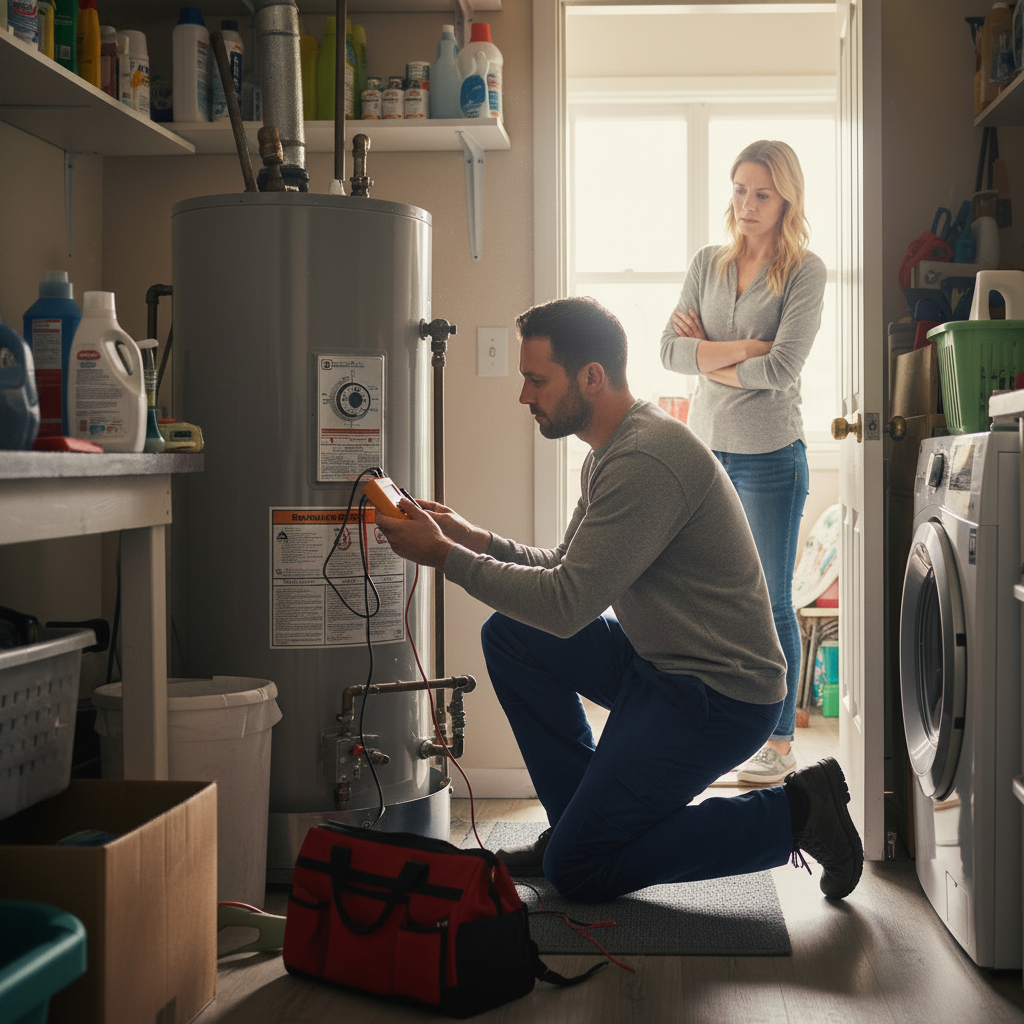
Emergency diagnosis is different from routine service — we're working backwards from a symptom that's already causing disruption. The goal is to identify the specific failure point quickly, determine whether it's repairable, and give you a clear recommendation without delay.
For gas units, the diagnostic path runs through the pilot assembly, thermocouple, gas control valve, and burner — in that order, because that's the order of likelihood. For electric units, we check the breaker, heating elements, and thermostats. For leaks, we identify the source: valve, fitting, or tank body. The source determines everything that follows.
- Gas units: pilot → thermocouple → gas valve → burner, tested in order
- Electric units: breaker → upper element → lower element → thermostat
- Leaks: isolate the source — drain valve, supply connection, or tank body
- We test before recommending — we don't guess at the cause
- You see the same diagnosis we see before any decision is made
Emergency Water Heater Repair in Fairview, TX — Complete Guide
What to Know When Your Water Heater Fails Suddenly
A sudden water heater failure is disruptive and, in some cases, genuinely dangerous. Understanding what's happening with your unit — and what your options are — helps you make better decisions under pressure. This guide covers the key scenarios, safety steps, and how the repair-vs-replace decision works in an emergency context.
Recognizing a True Emergency
Not every water heater problem is an emergency, but several situations demand immediate attention. An active leak from the tank body is always urgent — water damage compounds quickly and the tank cannot be patched. A gas smell near the unit is a safety emergency that requires evacuation and a call to your gas utility first. Complete loss of hot water in a household that depends on it — particularly with elderly residents, young children, or medical needs — is a priority call.
Other situations may be urgent but not dangerous: a pilot that won't stay lit, rumbling during heating cycles, or water that's only lukewarm. These warrant a prompt call but don't carry the same immediate safety risk. When in doubt, call — we help you assess the urgency over the phone.
Safety First — The Steps That Come Before Repair
Before any repair work happens, the situation needs to be stabilized. For a leaking tank, that means shutting off the cold water supply valve above the unit. For a gas smell, that means leaving the area and calling the gas utility. For an electrical failure, it may mean leaving the breaker alone until a professional can assess it.
These steps aren't the repair — they're what prevents the situation from getting worse while help is on the way. We walk you through them over the phone when you call, because the first few minutes of an emergency matter more than anything that happens after.
Gas Water Heater Emergency Failures
Gas water heaters fail in specific ways. The most common emergency is a pilot light that won't stay lit — usually a failed thermocouple, the safety sensor that tells the gas valve the pilot is burning. Without that signal, the valve shuts off gas as a safety measure. The repair itself is straightforward, but it requires a technician because it involves the gas system.
Gas control valve failures are less common but more serious. The valve can stick shut (no gas, no heat) or behave erratically, producing intermittent hot water. On a newer unit, valve replacement is often worth the cost. On an older unit, it may point toward replacement. A rumbling gas heater usually means sediment has accumulated above the burner — the unit is working harder and the tank is aging faster. We assess whether a flush can help or whether the tank has already deteriorated past that point.
Electric Water Heater Emergency Failures
Electric water heaters fail differently from gas units. The most common sudden failure is a burned-out heating element — often the upper element, which handles the first recovery cycle. When it fails, the unit stops producing hot water entirely or produces only lukewarm water. Element replacement is a defined repair that doesn't usually indicate the unit is failing overall.
A tripped breaker is another common call. If resetting the breaker once restores hot water and it doesn't trip again, it may have been a transient surge. If it trips repeatedly, there's a short or overload in the heating circuit that needs professional diagnosis. Thermostat failures can also cause temperature issues — water that's too hot, too cool, or fluctuating.
When the Tank Body Itself Has Failed
If water is leaking from the steel shell of the tank — not a valve, not a fitting, but the body itself — the tank wall has corroded through from the inside. This is the one scenario where repair is not an option. No patch, sealant, or external fix can safely restore a breached tank wall. Replacement is the only correct path.
We confirm this in person by isolating the leak source. If it's from a drain valve or supply connection, a repair may be possible. If it's from the tank body, we explain clearly why replacement is necessary and help you move forward with that decision. Tank body breaches often happen after years of internal sediment accumulation and anode rod depletion — the same aging process that affects older units in Fairview's housing stock.
Permit Considerations for Emergency Replacement
When an emergency failure leads to replacement, permit requirements may apply. Permit rules vary by municipality. We recommend contacting the Town of Fairview's building department directly to confirm current requirements for your specific situation before installation proceeds.
In a true emergency, the immediate priority is stabilizing and restoring hot water. Permit considerations are addressed as part of the process — we help you understand what may apply and recommend confirming with the town directly.
What the Emergency Repair Process Looks Like
Call us — we answer 24/7
Describe what you're experiencing. We assess whether there's an immediate safety step you should take right now — shutting off water, gas, or power — before we dispatch.
We help you stabilize the situation
Over the phone, we guide you through shutting off the cold water supply valve or the gas valve if needed. Stabilizing first prevents further water damage or safety risk while help is on the way.
We diagnose the failure on-site
In person, we identify the specific cause — tank breach, failed thermocouple, tripped breaker, element failure, or valve malfunction. We don't guess; we test.
We give you the options with real numbers
You hear what failed, what it costs to fix, and whether a repair will hold given the unit's age and condition. If replacement is the safer call, we explain why with the numbers in front of you.
You decide — we work at your pace
The information is yours. Whether you choose repair or replacement, we proceed only after you've decided. No pressure, no upsell.
Emergency Repair Questions — Fairview, TX
Water Heater Emergency in Fairview, TX?
Active leak, no hot water, or gas smell? Call 24/7. We help you stabilize first, then diagnose the specific failure and give you honest repair-vs-replace guidance — no pressure, no upsell.
After You Reach Out
What Happens When You Call
- 1
You call — we answer any time, day or night
24/7. Describe what you're seeing — active leak, no hot water, gas smell. We assess immediate safety steps first.
- 2
We guide you through stabilization
Shutting off the cold water supply valve, or the gas valve if there's a smell. Preventing further damage while help is on the way.
- 3
On-site diagnosis of the specific failure
Tank breach, thermocouple, breaker, element, or gas valve — we test and identify the actual cause, not a guess.
- 4
Repair-vs-replace guidance with honest numbers
If the unit's age makes repair a poor investment, we tell you directly and show you why with the numbers.
- 5
You decide and we proceed
The decision is yours. We work at your pace with no pressure either way.
Ready to get help?
Call for the fastest response — we're available 24/7. Send a message if it's not urgent — we'll follow up promptly.
Call 24/7 Now — +1 469 824 3854Mon–Fri: 7:00 AM – 7:00 PM · Sat: 8:00 AM – 5:00 PM
Request Emergency Water Heater Repair in Fairview, TX
Describe your situation and we'll follow up promptly during business hours. For urgent issues, call +1 469 824 3854 — it's faster.